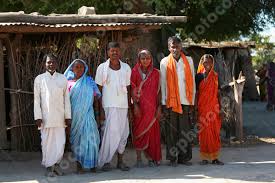
The Andh are a designated Scheduled Tribe in the Indian states of Telangana and Maharashtra. They seem to have originated in southern India in the vicinity of Madras which was once ruled by the Andhra dynasty. However the identification is only used for the people who by the start of the 20th century had a long history of residence in central India. The Andh are a designated Scheduled Tribe in the Indian states of Telangana and Maharashtra.
Andh claim themselves to be the original descendants of Andhra dynasty or Satvahana dynasty that ruled between third century BC to second century AD. The word Andh is derived from the word Andhra community . The Andhs live primarily in the hills of the Adilabad district in Andhra Pradesh. They are further subdivided into the Vertali and the Khaltali. The Vertali consider themselves as superior people and avoid marrying the Khaltali. Andhs are dark in complexion,with thick lips, and prominent cheeks bones. “It seems highly possible that the word Andh is only a corruption of the Sanskrit ‘Andhra’, a designation given by the ancient Aryans to an aboriginal Tribe dwelling in the Andhra Desh ” .
In Maharashtra the Andh community comprise 474110 population (census 2011). Andh people are distributed in Parbhani, Nanded, Yeotmal, Akola districts mainly. They called them self Hindu and are relatively well progressed in education. According to the Anthropological Survey of India, there are over 74,000 Andhs in Maharashtra. These Andhs speak Marathi. The Andhs are primarily Hindus.About 100,000 Andh speak the Andh language. In Maharashtra the Andh community comprise 474110 population (census 2011). Andh people are distributed in Parbhani, Nanded, Yeotmal, Akola districts mainly. They called them self Hindu and are relatively well progressed in education.
They are considered as the non-Aryan tribe belonging to the Tamil country. In the past, the region of the Andhra dynasty expanded across the southern region of the country. The Andh is segregated into two endogamous groups, namely, Vartali and Khaltali. Andh tribes comprising the Vartali segments are considered to be elites, while those falling into Khaltali segments are commoners. Intermarriage is prohibited between them. Again, Andh tribes are further divided into a number of exogamous family lines mainly carrying the surnames ‘Intiperlu’. These clans are named after some animals or plants. Some of the names are Majiria the cat, Baghmare means tiger killer, Titawe from Titawa, which means a bird, Dukare from Dukar, meaning a tiger, Ringni, a type of tree, Dumare from Dumar, meaning an ant-hill.
Marriage ceremonies of Andh tribe resemble the wedding ceremonies of Kunbi tribe. Engagement ceremony is arranged between the months of October and December in Andh tribal communities. And the wedding usually takes place in between January and April. In Andh tribal societies, polygamy is also allowed. Widow re-marriage is widely prevalent among Andh tribes. However, no widow is allowed to remarry the brother of his late husband. Remarriage with other members of the same family line is also not accepted. Divorce is also permitted. In their societies, dead are usually buried. They bury the dead with its head facing the south direction in contrary to the customs of Hinduism.
Andhs are non vegetarians although they avoid consuming beef. Andhs are mainly agriculturists by profession; many of them work as labourers also. There are only few people who live on forest products that they have accumulated during hunting. Fishing too is also prevalent. They have caste committee or Panchayat. The general customs and traditions of Andhs reflect their aboriginal origin. Andh tribes are going for minimum education.
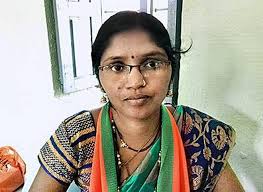
Pote Shobhabai, belonging to Andh tribe, became the first-ever public representative from her tribe, which is categorised as Particularly Vulnerable Tribal Group, after she was elected Indervelli Mandal Parishad president on Friday. A resident of Dasnapur village, she represents the same Mandal Parishad Territorial Constituency for the BJP. The Andh is a tiny Adivasi community, its population being around 10,000 as per the 2011 Census. The tribe is scattered mainly across Adilabad and K.B. Asifabad districts. There are a few teachers from this tribe, but it is mostly mired in poverty.

