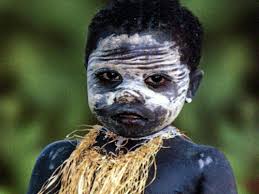
Jarwas is the name of a tribal community which is residing in Andaman & Nicobar Islands. They live in parts of South Andaman and Middle Andaman Islands, and their present numbers are estimated at between 250–400 individuals.
In 1857 Captain John Campbell, a senior British Officer and consultant for the Council of Indian Government, wrote in favor of selecting the Andaman Islands as a penal settlement. “Convicts cannot be prevented from escaping when working on the mainland, but they cannot get away from the Andamans, as the savages are far too hostile to allow one to escape.” J. Walker, reporting to C. Beadon, Secretary to the Government of India, stated that within ten months, 240 of the first shipload of 733 convicts had been found killed by native arrows in the vicinity of the penal settlement. Seventy prisoners were reported to have escaped and disappeared without trace .
In the early twentieth century, Port Blair was developed as an administrative seat and the region around it was developed using prisoners from mainland India. The forest was cleared with the aid of Andamanese tribal people (of the Aka Bea and Kol groups) who were employed as guides. The Jarwas, the tribal group discussed in this essay, frequently attacked the people they saw as invading their territory. In retaliation, Andamanese and Burmese forest workers and sepoys were often ordered to undertake “punitive expeditions.” Vacant Jarwa campsites in the deep forest were invaded by armed people, ransacked and set alight. Various objects such as metal implements, arrows, pots and baskets were seized and removed, mostly to establish if any escaped convicts were living among the Jarwas, a fact that was never really established. Reports suggest that face-to-face confrontation led to fatalities on both sides and to the capture of Jarwa women and children, who were then taken to Port Blair.
Frequently gunfire and arrows were exchanged at close range. Not only did this result in a loss of life on both sides, but “a great deal of blood” was found on the trail after the firing had ceased — but seldom were the Jarwas themselves traced. In a 1925 expedition, 37 dead Jarwas were accounted for, reflecting the intense nature of such punitive expeditions. Similar contact, violence and destruction occurred on Little Andaman Island between the Ongee and settlers until the mid-1880s (Portman 1899).
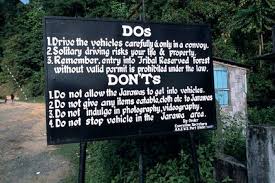
Jarwas are one of the last remaining tribes in this part of the world not to be assimilated to any degree with the outside society. Jarwas are confined to 765 square kilometers of forest, an area which has been declared a Jarwa reserve. This area was set apart by the Tribal Act of 1956 for the Jarwas’ use and to keep them contained and protected. Around its perimeter the number of settlers continues to increase. Whether these tribal groups should be kept isolated in a “human zoo” or encouraged to become part of the cultural mainstream is a long-standing question for India. The issue is complicated by the question of whether the Jarwas really know that a boundary exists between their forest and the forest beyond which is being invaded by the world. It is beyond doubt that Jarwas frequently experience non-Jarwas extracting wood and other forest resources, including wild pigs, a prime Jarwa food. The only indication that a boundary exists between them is a series of signs indicating the limits of Jarwa territory. Both Jarwas and non-Jarwas frequently cross over and the boundary remains a misunderstood notion, despite the presence of police to enforce it.
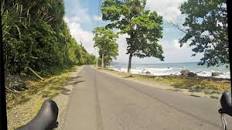
Since the completion of the Andaman Trunk Road in 1988, private and commercial traffic has begun passing through the Jarwa reserve. The 23 kilometer stretch of road has brought an increasing number of outsiders close to the Jarwas. Bus loads of people travel northward from Port Blair along this road accompanied by armed escorts from the Andaman Nicobar Police Force. During construction of the road, workers were often targeted by the Jarwas, and a police escort is now provided in case the Jarwa attack or try to stop vehicles passing through their territory. Drivers of all vehicles are expected to refrain from sounding their horns so as not to disturb any Jarwas hunting in the forest.
In the last 10 years police camps have been established within the Jarwa reserve to serve as warning posts and to protect settlers by scaring the Jarwas away with gunfire. The police, while originally intending to protect the Jarwas, today are seen as a force for the protection of settlers. In October 1991, Jarwas attacked the police camp at Jhirkatang and one policeman was killed. In defense (or retaliation) the police claimed to have fired three hundred rounds “in the air.” According to the Jarwas, the individual killed in this attack was a poacher of wild pigs within the Jarwa territory. Settlers, on the other hand, tell of brave individuals who defended themselves against the “wild savages” in the forest.
In 1970 the Jarwas were officially contacted by the Indian government. Since 1974, contact with the Jarwas on the western coastline has been regular, systematic and increasingly friendly. These contacts are organized by the government-administered agency for tribal welfare known as Andaman Adim Jan Jati Vikas Samiti (AAJVS). Every full moon and depending on the weather, AAJVS organizes a team of people who travel by boat to the western coast of Middle Andaman via Kadamtalla. The team includes administrators, a doctor, an officer from the statistics department and an anthropologist from the local anthropological survey office.
As the ship reaches the coastline it starts sounding its horn, searching for Jarwas moving out from the forest. Upon sighting the Jarwas, the ship is brought to a halt and smaller motorboats are loaded with raw bananas, coconuts, strips of cloth, metal pots and nails. While members of the contact party make their way to the sandy coastline, in another boat members of police, not allowed to land on the beach, remain on alert for any undesirable events. On average about 20 people are contacted at any given spot. Sometimes only women and children are contacted. At other times a large group of 50 to 60 appear.
As the boat loaded with gifts approaches the beach, the Jarwas, with their woven baskets, come out to meet it scrambling for the gifts brought by the contact party. The Jarwas try to pick up what they can and fill their baskets. Often the other members of a family help: picking up what they can and filling baskets, depositing their contents on the beach and returning to collect the next load. Running between the boat and the beach the Jarwas sing in a repetitive chant-like tone. As gift items are unloaded and distributed among the Jarwas, the contact party disembarks and cautiously moves among the Jarwas congregated at the beach. On occasions the distributed food is shared between the Jarwas and the contact party. During this time the contact party makes audio and photographic records, notes the number of Jarwas present, whether there are any visible signs of sickness, injury, or if there is anyone needing medical attention.
The Jarwas are also involved in their own observation of the contact party. Variations in body size and shape, the clothes and skin of the contact party are carefully scrutinized by the Jarwas. Sometimes they mimic the sounds most often repeated by the contact parties. Over time the Jarwas have learned that the contact party has instruments like tape-recorders, cameras, and video cameras. The Jarwas have heard the tapes played back to them; they have seen what the world looks through the viewfinder of a camera. On some occasions Jarwas have shown the contact party objects like eyeglasses, metal pots, clothing and camera cases procured on the previous contact event. Generally within three to four hours the event is brought to an end. Slowly the Jarwas begin picking up their loads of gifts and start moving into the forest. The contact party waves goodbye to the Jarwas and returns to the ship.
Many of the observations made in this way have confirmed what was known about the Jarwas since the days of British occupation of the islands, and much of the basic information has remained constant (Temple 1903, Portman 1899; Sarkar 1990). But information gathered in the span of a short contact encounter repeated three to five times a year is subject to range of interpretations and misrepresentations. There is no systematic record of the people contacted, even the number of Jarwas living in the region is not definite. It is even questionable whether the Jarwas refer to themselves as Jarwas or not. Some administrators have questioned the benefit of these contacts to the Jarwas (see this issue’s Not in the News page 42). Most of the people involved in the contact event regard it as an extremely tiring and risky chore that they have to do and that they would like to get it over with quickly. After the event, a radio signal is sent to Port Blair that the mission was successfully accomplished under the leadership of the senior government staff member accompanying the team. The estimated number of Jarwas contacted is relayed. This information is broadcast on the radio news across the whole island.
The contact event and the contact team’s role have changed over time, as has the Jarwas’ response to them. In the early contact phase, items like cooked rice and plastic trinkets were distributed. Soon it was realized that such items were a health hazard and a cultural imposition, and such distributions were stopped. Also, the right to join the contact party is now strictly controlled. Gone are the days when any visitor of importance was allowed to accompany the contact team in order to see the “exotic primitives living in harmony with nature.” Those involved with the Jarwas over long periods of time are split among themselves about the objective of the mission: some feel that regular contact instills mutual trust and encourage the Jarwas to join the mainstream of society; others feel that nothing is accomplished or learned by any involved.
A policy that is no longer encouraged is the embarkation of Jarwas on board the contact ship. This was reviewed after an incident in 1977 when two Jarwa men, having spent time in Port Blair, were returned with the hope that they would carry the message of trust and goodwill. Soon after, five poachers were killed by Jarwas in the region where the visitors to Port Blair had been dropped. Eventually the contact parties stopped bringing Jarwas to the Uttara Jetty of Kadamtalla where they, and the non-Jarwas, had become a curious exhibition for each other (AAJVS 1994). Yet, as late as 1983-84, the Jarwas exhibited eagerness to come on board the main ship and, if possible, take more gift items, including any piece of metal they could disconnect from the ship’s decking. Some veteran members of the contact party remember that in the earlier days of contact the Jarwas were like mischievous children who would not hesitate to take things from the contact party members and hide them away. Incidents like these raise questions about boundaries, authority and power relations. The evidence suggests that the Jarwas understand the relations of power but not the boundaries that, from the authorities’ point of view, limit them.
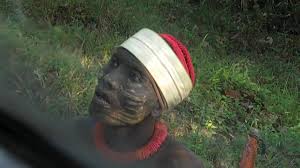
The news of successful Jarwa contact often raises the question: What has been achieved by such events? Some islanders feel that more vigorous efforts should be made to transform the Jarwa; that they should be made to give up their wilderness existence and be civilized quickly. Some from Ferargunj in the Andaman Islands said to me, “Giving little gifts here and there is not achieving anything. It is just a slow and corrupt way of scheming off money in the name of tribal welfare! In fact, it is making the Jarwas learn to depend on all assistance being given by the outsiders.” A school teacher in Tirur said, “Look there is a lesson of history that we are ignoring: outsiders continued to give help and all forms of assistance to the Great Andamanese and made them settle down in Strait Island. Are they self-sufficient and happy today?” The Great Andamanese is a group of 20-odd individuals of conflicted cultural identity: caught between being citizens of India and expecting special treatment, they are descended from a significant tribal group that has dramatically dwindled.
Some students at Tirur settlement pointed to the overlooking hills and said that they were aware of the fact that Jarwas can come out from the forest. In 1991 the Jarwas came out and killed an eight-year-old boy who was playing at the edge of the fields while his sister watched the family’s cattle. The school children, on being asked what they thought Jarwas were, narrated a story about the de-evolution of trained elephants that were left behind by timber contractors after the Second World War, eventually becoming fetal in the forest. “The Jarwas are like the elephants: they came from some kingdom across the sea and got stranded in the forest here, and over a period they forgot all their civility and shame. They became wild.”
While many villagers feel that the nature of the contact with the Jarwas should be changed and accelerated to civilize and discipline them, Port Blair residents, many with a commitment to environmental heritage, feel very differently. In their view, contact is not only useless, it is destroying the autonomous, healthy, natural exist ence of the Jarwas as hunters and gatherers. They feel that all contact with the tribes like Jarwas should be completely stopped.
Even if it were decided that contact with the Jarwas should cease, the question remains: Will the Jarwas stop contacting non-Jarwas? One of the major concerns of the growing number of settlers around the Jarwa reserve forest is the occurrence of incidents associated with Jarwa hostility. Jarwas come out to the small settlements, carrying away clothes hanging outside, metal utensils and tools; consume fruits from planted banana and coconut trees, destroying fences and the thatching of the houses; dogs or livestock have been killed with arrows. To a degree, the settlers around the Jarwa reserve forest are now used to these incidents. They report them to the local administration when they happen and claim compensation. Each person killed by Jarwa results in a government payment of about $350 as compensation for the loss. All hostile attacks involving death are registered as crimes under the Indian Police Code. However, in practice, the courts tend to accept the final report of the police that the accused could not be traced or arrested and the criminal case against Jarwas is often abandoned. What settlers fear most are the occasions on which Jarwas appear to have selectively killed individuals in the settlement. People believe that those who are targeted by the Jarwas have often been spotted by the Jarwas in the forest trying to hunt or extract forest products, both of which are prohibited activities.
The folk notion that Jarwas punish settlers involved in illegal activities is questionable however, since it implies that the Jarwas seek out these culprits. It is not even clear that the Jarwas recognize the boundaries that separate them from the settlers and contacts with the Jarwas are such that their version of these events cannot be elicited.
Yet it cannot be denied that Jarwas resent outsiders exploiting their forest. Occasionally, a settler’s body is recovered from the Jarwa reserve; while bodies mutilated with Jarwa arrows have been recorded at local police stations as “killed by the Jarwas within the reserve forest.” The settlements that the Jarwas are most likely to raid are those nearest the Jarwa forest and settlers have chased Jarwas away by firing guns or have been shot at by Jarwas arrows. Available records for 1983-88 indicate that 28 hostile incidents were reported to administration. Of these, 20 attacks were in settlements and eight in the reserve forest. In the period from 1946-61, 76 encounters were registered at the district headquarters and 15 settlers were killed, no records exist of Jarwa losses for this period. In most of the reported incidents of Jarwas entering settlements, death is infrequent (Mann 1973). It must be noted that there are no records of damages and losses sustained by the Jarwas. Nothing is recorded or reported about how the settlers may have hurt or killed the Jarwas while conducting prohibited activities in the Jarwa reserve forest. Historically, Jarwas never leave behind an injured or dead body and contact parties have often reported observing Jarwas with bullet wounds.
For other Andaman Islanders like the Ongees and the Great Andamanese different kinds of changes have taken place. One hundred and one Ongees continue to live on Little Andaman with various forms of government aid and welfare programs. Twenty-odd Great Andamanese are still settled on Strait Island. Both Ongees and Great Andamanese maintain a lifestyle different from the old ethnographic accounts, learning to count in Hindi and occasionally watching the video monitor. In comparison, the world of the Jarwas remains relatively unchanged.

 santhoshi's blog
awsome post
LikeLike